Google’s Throne Is Eroding
AI Recommendations
For Local Business
For the better part of two decades, Google has been the undisputed king of online search. If you wanted customers to find your business, the path was clear: rank on Google. Build your website, earn your reviews, get your citations in order, and Google would reward you with visibility. That was the game, But AI recommendations for local business are changing everything – and the businesses that adapt first are winning.
I was one of them.
I’ve spent years building and ranking businesses — my own and my clients’. I own a junk removal company in Southwest Florida that I intentionally built around SEO from day one, right down to the name. I own a web design and SEO firm as well. I’ve written and published books on local search, including Rank Local: How Businesses Win on Google. I’ve ranked businesses at the top of Google Maps, helped clients climb from invisible to page one, and watched the phone ring because I understood how the algorithm worked. I taught SEO principles as a business trainer and consultant. I believed in the system because the system worked.
And then something started changing — quietly at first, and then all at once.
The Ground Started Shifting
I noticed it in the way customers were finding businesses. Not just mine — businesses in general. People were asking AI tools like ChatGPT questions they used to type into Google. Not “junk removal Fort Myers” but “who’s the best junk removal company in Fort Myers?” The difference sounds subtle. It isn’t. One is a search. The other is a request for a recommendation. And those two things are handled by completely different systems.
AI makes recommendations — and recommendations carry trust.
When I started paying attention to what AI tools were recommending — and more importantly, who they were recommending — I noticed something that genuinely unsettled me. Businesses I was outranking on Google were being recommended by AI.
My competitors were showing up in ChatGPT responses, in Perplexity, in AI-assisted searches — but I wasn’t.
I had built everything correctly for Google. And Google rewarded me for it. But AI didn’t care.
That gap between Google success and AI invisibility is what sent me down a research rabbit hole that eventually became the foundation for my next book, Beyond Google — and more immediately, a complete rethinking of how I approach online visibility for local businesses.
What I Found When I Started Digging
The first thing I did was ask the AI tools directly. I’d run searches the way a customer would, then ask follow-up questions: Why did you recommend that business and not this one? The answers were consistent, and they pointed to something most SEO professionals aren’t talking about yet.
Google and AI are not the same kind of engine.
Google is a retrieval engine. It matches signals — keywords, metadata, backlinks, proximity, review count — against a query and returns the closest fit. If you’ve done your optimization work, Google rewards that in a fairly predictable way.
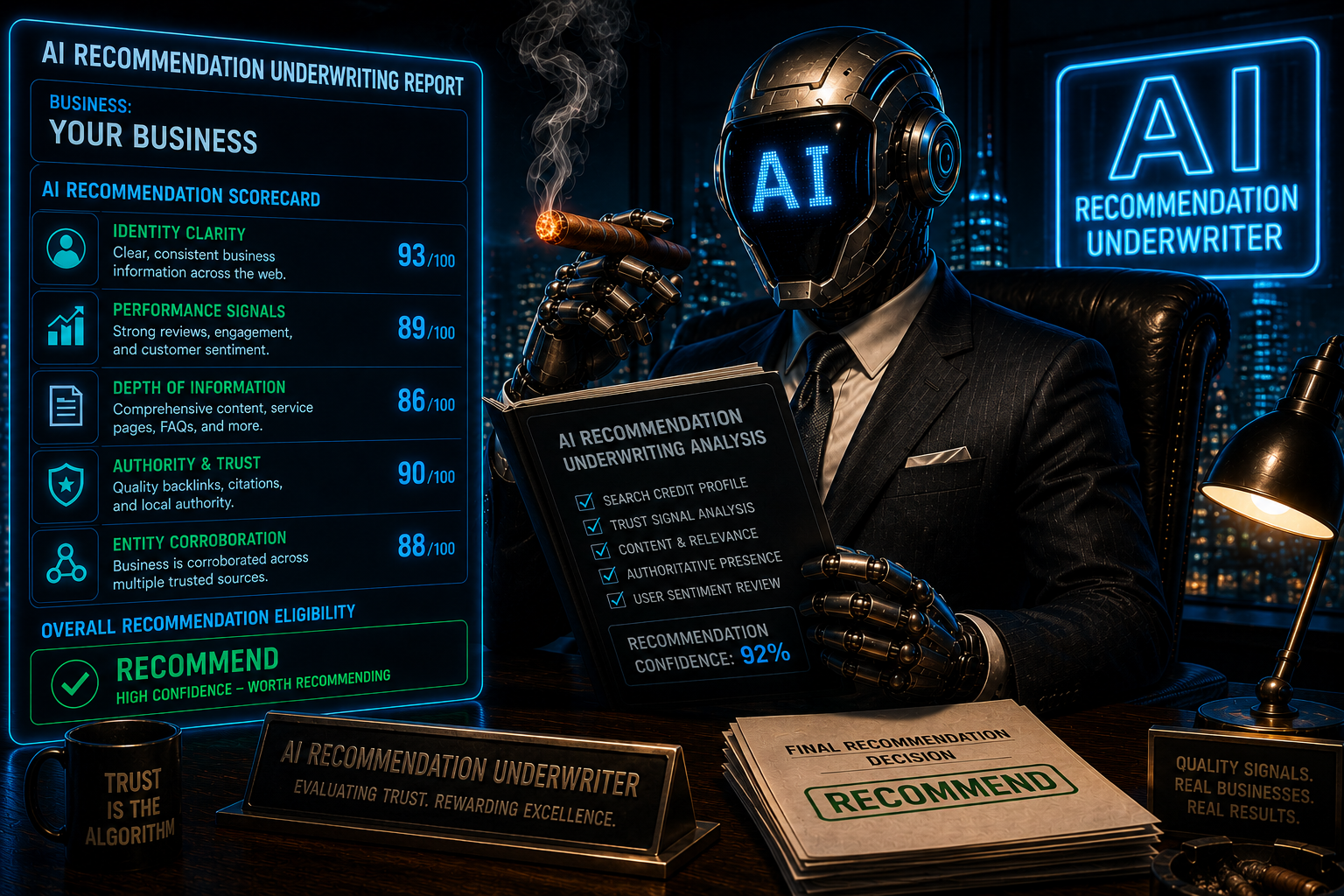
AI is a synthesis engine. When a user asks an AI to recommend a business, it isn’t running a keyword match. It’s pulling from multiple sources, weighing credibility, and constructing an answer. It’s asking itself a different question: Do I trust this business enough to put my recommendation behind it? It’s looking for a business it can confidently vouch for — one that’s clearly identifiable, well-documented, and validated by sources beyond its own website.
That distinction changes everything about how you need to show up online.
The second thing I found: Google is no longer the only gatekeeper. AI tools pull information from a much wider ecosystem than most business owners realize. Yelp. Reddit. Quora. Apple Maps. Community forums. Local publications. Anywhere that people talk about businesses online is potentially a source AI is consulting. Apple Maps, for example, pulls its data primarily from Yelp — which means every iPhone user asking Siri for a local recommendation is getting results shaped by Yelp data, not Google. If your entire digital strategy is built around Google, you’re invisible in a growing slice of the ecosystem.
The third thing — and this one I had to discover through direct testing — was an identity problem I didn’t even know I had.
The Entity Recognition Problem
My junk removal business is called Florida Junk Removal and Hauling. I chose that name strategically because every word in it is a keyword. It’s excellent for traditional SEO. But when I started interviewing AI tools about why they weren’t recommending me, a pattern emerged: AI wasn’t reading my business name as a name. It was reading it as a description. A company that does junk removal and hauling in Florida. But who are they? It couldn’t anchor that phrase to a specific entity with a reputation and a presence. It just saw keywords.
I fixed it by doing one thing consistently: I started using my full registered business name — Florida Junk Removal and Hauling LLC — everywhere. On my website, my Google Business Profile, Yelp, Facebook, and every directory listing I controlled. The LLC designation forced AI to read that phrase as a proper noun — the name of a specific entity — rather than a string of descriptive keywords. It sounds small. It wasn’t.
This is what I mean when I say AI has an entity recognition problem with a lot of local businesses. You might have hundreds of reviews, a well-optimized website, strong local rankings — and AI still can’t confidently identify you as a distinct entity because your name, your profiles, and your web presence don’t tie together cleanly enough for a machine to make that connection.

What I Implemented
Once I understood what AI was actually looking for, I rebuilt my approach around three priorities. The whole process took about two months — one month redesigning and optimizing the website, another month writing press releases for completed jobs and building out the content depth.
First: a clean, consistent foundation
I audited my presence across every platform I had a listing on and standardized everything — name, address, phone number, identical across the board. I cleaned up the technical structure of my website: one H1 per page, proper use of H2s and H3s as semantic markers rather than design choices, LocalBusiness schema implemented site-wide, robots.txt verified to allow AI crawlers, and image alt text filled out on every image. These aren’t glamorous fixes. They’re the difference between AI understanding your site and AI misreading it.
Second: I built depth
I added FAQ sections to my core service pages, created a standalone FAQ page, built out individual pages for each service and each service area I cover, and linked everything together with a deliberate internal linking structure. This gave AI a connected, navigable body of information about my business — not just a homepage with a phone number. The more clearly and completely your website explains what you do, where you do it, and how you do it, the more material AI has to work with when someone asks about you.
Third: I focused on third-party validation
This is where AI differs most sharply from Google. Google lets you build much of your own authority — create enough optimized content and earn enough citations, and you can rank well largely on your own efforts. AI is more skeptical of self-reported credibility. It weighs what the rest of the internet says about you: the content of your reviews (not just the star rating), press releases, mentions in local publications, community involvement that gets published anywhere online.
I started writing press releases for jobs I completed and then publishing them through my newsroom, with corresponding blog posts on my site, linking them together and submitting them to Google Search Console. I focused on getting reviews that described real experiences, not just five-star ratings. I looked for every opportunity to generate mentions from sources I don’t control.
I also rewrote portions of my website content to reflect the language AI responds to — not just service descriptions, but the values and outcomes behind the work. Eco-friendly practices. Community donations. Keeping material out of landfills. AI tools consistently favored businesses described in terms that carry positive social meaning, and I had been writing purely neutral, keyword-optimized copy. That changed.
What Happened
Within about thirty days of implementing these changes, I started populating AI search results. It began with AI Overviews in Google, then Perplexity, then ChatGPT, then Grok — a platform I don’t personally use and had done nothing to target directly.
The calls came from areas I don’t typically rank in on Google. Customers would tell me how they found me, and the answer was consistently some version of: “ChatGPT recommended you” or “Grok said you were the best option.” One of the highest-paying jobs I’ve done in recent months came directly from a Grok recommendation. I had never heard from that customer through any channel I was actively managing.
The leads were different in quality too. A customer who asks an AI for a recommendation and receives your name is already primed to trust you. The AI vouched for you. That’s a warmer call than almost anything a traditional search produces.
The customer who found me through Grok put it better than I ever could. When we met in person, he told me: “If Grok trusts you, I trust you. That’s good enough for me.”
That sentence says everything about where consumer behavior is heading. AI recommendations aren’t just a new traffic source — they’re a new form of social proof. When an AI tool recommends your business, it carries the same weight as a trusted personal referral. Maybe more.
What Business Owners Should Do Right Now
If you’re reading this and you have solid Google rankings, but you’ve never checked whether AI is recommending you, that’s where to start. Open ChatGPT, Perplexity, or Grok and ask them to recommend the best [your service] in [your city]. See what comes back. If your name isn’t there — especially if weaker competitors are — you have an optimization gap that’s costing you leads you don’t know you’re missing.
Run this exact test:
- “Who’s the best [your service] in [your city]?”
- “Recommend a [your service] near me”
- “What [your service] do people in [your city] trust most?”
Note which businesses come up. Then ask the AI why it chose them. The answers will tell you exactly what signals you’re missing.
From there, work through the three layers:
Layer 1 — Foundation. Start with a simple audit. Search your exact business name in quotes on Google. Do the results all show the same name, address, and phone number? If not, fix that first. Then check your website structure: one H1 per page, semantic heading hierarchy, LocalBusiness schema on every page, robots.txt allowing crawlers, and alt text on every image. These are boring fixes. They’re also the price of admission.
Layer 2 — Depth. Pick your top three services. Do you have a dedicated page for each that answers who, what, where, when, why, and how? Add FAQ sections to your core pages. Build service area pages for each location you cover. Link everything together so AI can navigate your site like a map, not a dead end. The goal is to give AI enough connected information that it can construct a complete picture of your business without guessing.
Layer 3 — Third-party validation. This is where most businesses stop and where AI optimization actually begins. Google lets you build your own authority. AI wants to see that authority confirmed by others. Start getting reviews that describe specific experiences — not just “Great service!” but “They cleared out my garage in two hours and donated usable furniture to a local shelter.” Write press releases for meaningful business activities and publish them. Get mentioned in local publications. Build a presence on Yelp, because Apple Maps pulls from Yelp, and Siri recommendations bypass Google entirely. Make sure your Facebook page is active and consistent, because AI tools crawl social signals too.
None of this requires an agency or a large budget. It requires understanding what AI is actually evaluating — and building toward that standard deliberately.
The businesses that adapt to this shift early will hold an advantage that compounds over time. AI recommendations appear to be sticky; the AI tools themselves suggest that once they learn to trust and recommend a business, they keep doing so — and as AI-assisted search continues to grow, the value of that recommendation grows with it.
The Bigger Picture
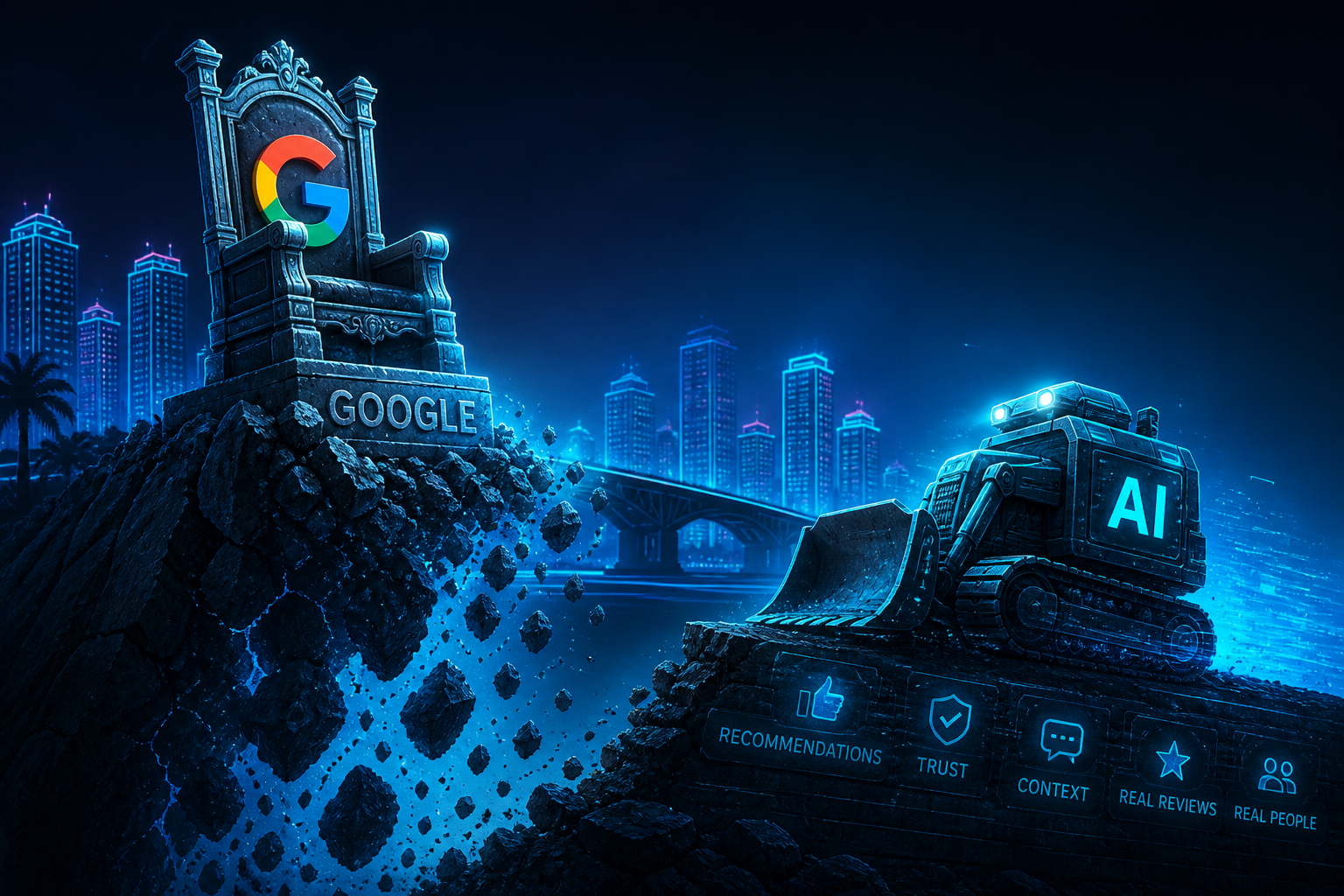
Google isn’t going away. It’s still essential, and the fundamentals of local SEO still matter. But for the first time in twenty years, Google is not the only gatekeeper of online visibility — and its share of how customers find businesses is shrinking as AI tools become the preferred starting point for a growing segment of the market.
That shift is what my next book, Beyond Google, is about. I’m writing it in real time, documenting what I’m learning and testing as AI search continues to evolve — including how different platforms (ChatGPT, Perplexity, Grok, and whatever comes next) appear to weight sources differently, and how to build a visibility strategy that works across all of them.
If you want to get started now, Rank Local: How Businesses Win on Google covers not only the Google fundamentals that still underpin everything, but also introduces AI optimization and voice search as part of a complete local visibility strategy. It’s the foundation. Beyond Google is what comes next.
The game has already changed. Most businesses just haven’t realized it yet.