
Google Just Changed The Rules
To Online Search
Here’s What Every Small Business Owner Needs to Know.
Google Just Changed the Rules.
Something big shifted in how Google works, and most small business owners have no idea it happened.
It is not being covered the way it should be. What coverage is out there is either too technical to make sense of or designed to sell you something. Neither of those helps you.
This post is different. I am going to tell you exactly what changed, what it actually means for your business, and what you need to do about it. Plain English. No hype.
What Happened

On May 19, 2026, Google held its annual developer conference called Google I/O. It’s the event where Google shows the world what’s coming next. This year’s announcement was the biggest change to Google Search in over 25 years.
Google’s own VP of Search called it “the biggest upgrade to our Search box in over 25 years.”
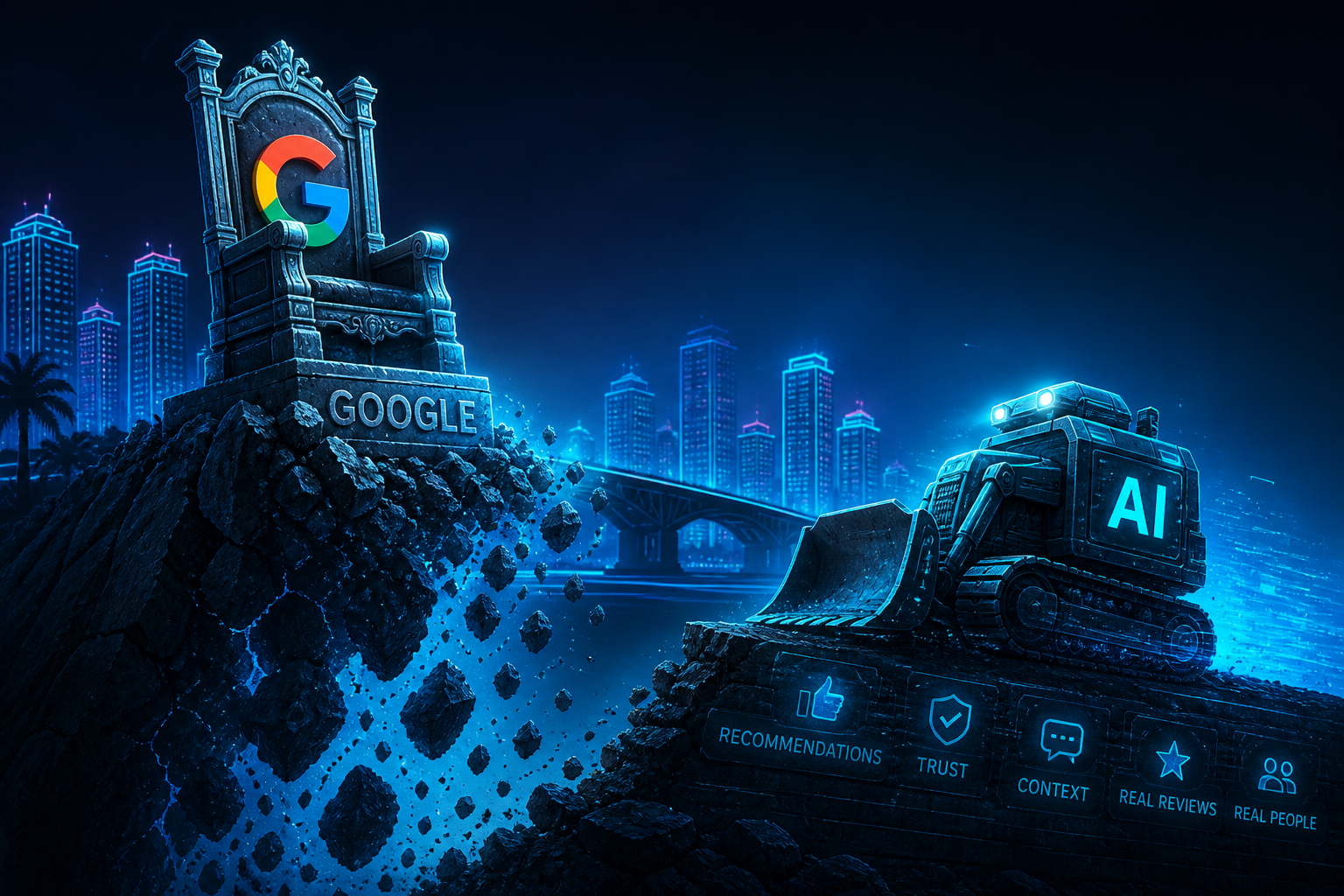
Here’s the short version: Google is replacing the old search experience with an AI that answers questions directly — without sending people to your website.
For the past 25 years, here’s how search worked. A customer had a question. They typed it into Google. They saw a list of websites. They clicked your link. You had a shot at earning their business.
That model is ending.
Here’s how it works now. A customer types a question — or talks to Google like they’re talking to a person. Google’s AI reads thousands of websites in seconds, puts together an answer, and gives it directly to the customer. No clicking required. The customer gets the answer. You get nothing.
Google calls this “AI Mode.” It now has over one billion monthly users — and it only launched one year ago. Queries are more than doubling every quarter.
More people are searching than ever before. They are just visiting websites far less.
The Numbers Are Not Pretty

This is not a rumor. The data is already in, and it is significant.
A real study published by Search Engine Journal, where researchers tested this on actual users between January and February 2026, found that Google’s AI answers reduced clicks to outside websites by 38% on the searches where they appeared. When people saw the AI answer, zero-click searches jumped from 54% to 72%. That means nearly three out of four searches ended without anyone visiting a website at all.
Another analysis found that 93% of searches done inside AI Mode end without a single click to an outside website. Ninety-three percent.
Search Engine Land reported that 73% of business websites saw significant traffic losses between 2024 and 2025, with an average drop of 34% year over year. Some industries lost between 40% and 70% of their organic traffic in a single year.
Here’s the part that should get your attention: this damage is happening even when your website still ranks on page one. You can be sitting at the top of Google’s results and still lose most of your traffic — because the AI answers the question before anyone ever scrolls down to see your listing.
Organic search used to drive about 53% of all website traffic. That number is shrinking fast.
What It Means in Plain English

Think of it this way.
You own a hardware store. For 25 years, when someone in town needed to know what kind of paint to use on a deck, they drove down your street, saw your sign, walked in, and asked you. You had a chance to help them, build trust, and make a sale.
Now imagine a robot set up a booth at the end of their driveway. The customer never leaves home. They ask the robot. The robot answers. Your store never comes up.
That robot is Google’s AI.
The old goal was to rank on page one. The new goal is to be the source the AI quotes when it builds its answer.
Think about that shift for a second. You are not trying to get people to your website anymore. You are trying to be trusted enough that Google’s AI recommends your business by name when someone in your area asks a question you can answer.
As one marketing analyst put it this week: “In the old model, a customer had a question. They searched. They saw your ad or your link. They clicked. You had a chance. In the new model, an agent has a task. It researches on its own. It forms a shortlist. The human sees the conclusion, not the process.”
Your brand needs to be in the answer. Not just on the list.
The Good News for Local Businesses

Here is where I want to slow down, because most of the content you will see about this is going to scare you. I want to give you a different perspective.
Local businesses are not in the same boat as big national websites and media companies. Those publishers are getting destroyed because their entire model was built on getting millions of clicks to ad-heavy pages. When the clicks stop, their revenue disappears.
You are not a publisher. You are a local service business. And local search still works differently.
WordStream’s 2026 Small Business Website Trends Report found that 60% of small businesses had not yet seen any impact to their website traffic from AI-assisted search. That window will not stay open forever, but right now, there is still time to get in position before your competitors figure this out.
More importantly, Google’s AI does not work in a vacuum. It pulls its answers from real sources. It recommends real businesses. And the businesses it recommends are the ones with the strongest trust signals. Your Google Business Profile. Your reviews. Your consistent presence across the web. Your website content. Your reputation in your community.
The game has not ended. The game has changed. And the businesses that understand the new game will clean up.
How the AI Decides Who to Recommend

This is the most important thing in this entire post, so read it carefully.
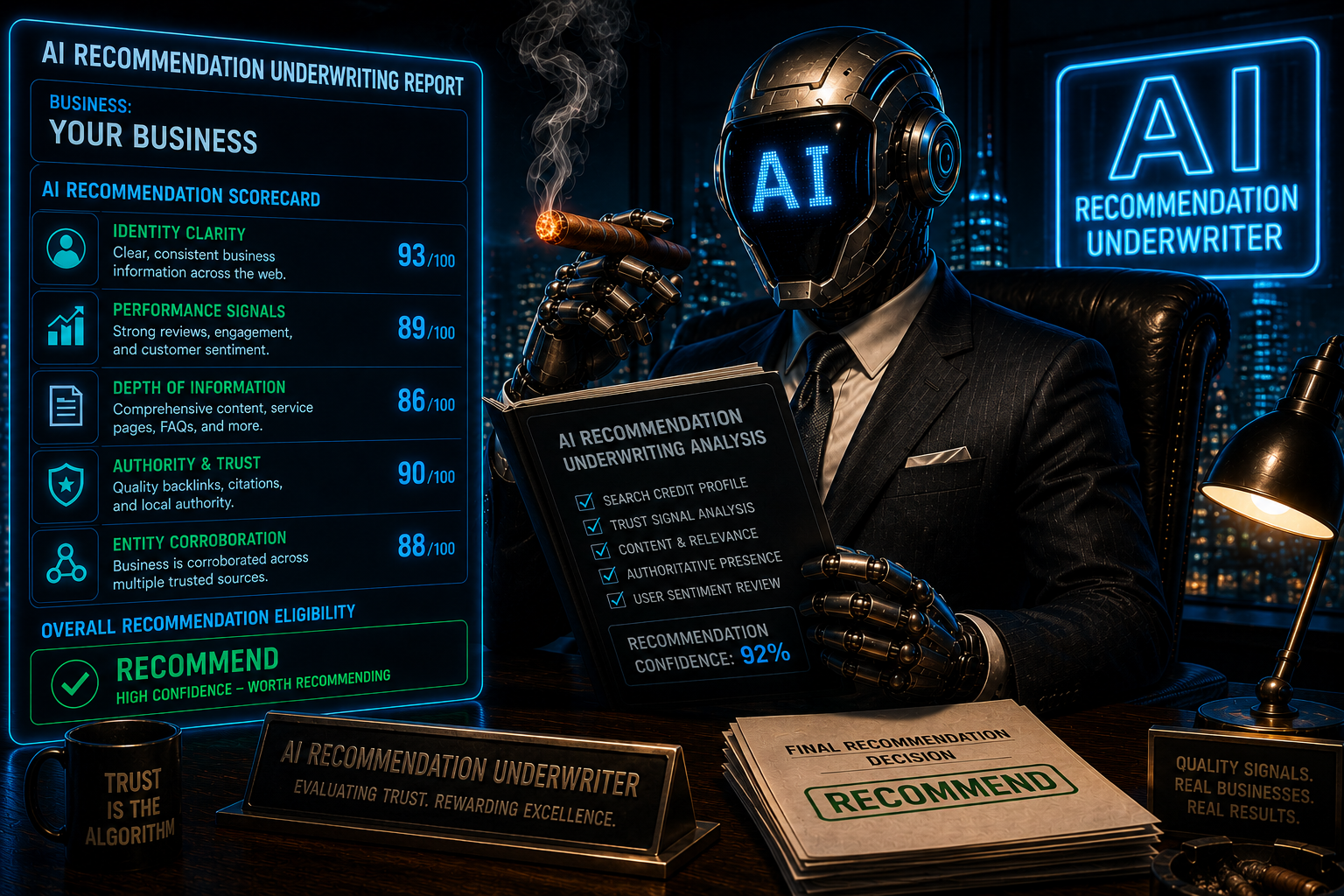
Google’s AI is not random. It does not guess. It is reading everything it can find about your business and asking itself one question: “Can I trust this business enough to recommend it to someone?”
Here is what it is looking at, according to multiple research studies published in 2026:
Your Google Business Profile. The Whitespark 2026 Local Search Ranking Factors report confirmed that your primary GBP category is still the number one factor for local visibility. But here is the new piece: a stale profile is no longer just a missed opportunity. Businesses that have not posted a meaningful update in over 30 days are seeing dramatic drops in GBP impressions. Google’s AI pulls from your profile in real time. If your profile is dead, the AI treats your business as inactive.
Your reviews. Reviews are no longer just social proof for customers. They are a ranking signal and a citation signal. The AI reads your reviews and pulls themes from them. Research from PinMeTo in 2026 found that a location with 12 reviews posted in the last 30 days gets cited more often than one with 200 reviews from 2024. Recency matters more than total count.
Consistency across the web. If your business name, address, and phone number say different things on your website, your Google Business Profile, Yelp, and other directories, the AI gets confused. Confused AI does not recommend your business. It moves on to someone it can trust. Accurate, consistent information everywhere is not optional anymore.
Your website content. The AI looks for websites that answer real customer questions clearly and directly. Not keyword-stuffed pages. Not thin pages with one paragraph and a phone number. Pages that actually help someone understand what you do, where you do it, and why you are the right choice.
A study published by Digital Applied in March 2026 found that brands cited inside Google’s AI answers earn 35% more organic clicks and 91% more paid clicks compared to competitors on the same search who are not cited. Being in the AI’s answer is more valuable than holding the number one spot below it.
How We Adjust

The adjustment is not complicated. But it does require consistency.
The businesses losing ground right now are the ones who built their entire online strategy around ranking high in Google search results and waiting for clicks. That passive strategy no longer holds up. The businesses gaining ground are the ones treating their online presence like an active, ongoing conversation with Google’s AI.
Here is the mindset shift: you are not trying to rank a webpage. You are trying to build a business that the AI understands, trusts, and recommends.
Every review you get teaches the AI something about your business. Every post you make on your Google Business Profile keeps your presence fresh in the AI’s understanding. Every consistent citation across the web adds another brick to your credibility. Every piece of content on your website that answers a real question gives the AI something useful to pull from.
None of this is new technology. Most of it is the same work local SEO has always required. The difference is that the AI turned up the dial on how much it rewards businesses that do this right — and how quickly it ignores businesses that do not.
What to Do Right Now

If you do nothing else after reading this, do these things.
1. Wake up your Google Business Profile.
Log in and look at it with fresh eyes. Fill in every field. Add photos. Post an update this week. Then make posting a weekly habit. According to Search Engine Journal, Google now treats your GBP as a live data source feeding its AI-powered results. A stale profile is invisible to that system.
2. Build a consistent review process — and stay out of the way.
Google updated its review policies in April 2026 and is actively enforcing them. You cannot tell customers what to write. You cannot suggest specific words, services, or locations. You cannot coach the content of a review in any way. What you can do is make it easy. Send your review link to every customer after the job is done. Make it a standard part of how you close every transaction. That is the entire strategy. The customers who had a great experience will say so in their own words, and that authenticity is exactly what Google’s AI is looking for. Review recency matters more than total count right now — a business with a steady flow of fresh reviews signals to the AI that it is active, trusted, and worth recommending.
3. Audit your consistency.
Search your business name across Google, Yelp, Facebook, and anywhere else you are listed. Your name, address, and phone number need to match exactly everywhere. One inconsistency is a red flag to the AI.
4. Rewrite the top of your most important web pages.
Google’s AI pulls from the first section of your page more than anything else. Research published by PinMeTo found that 44% of AI citations come from the first 30% of source content. Your opening paragraph needs to answer the customer’s question directly. Not “welcome to our website.” An actual answer.
5. Stop treating your online presence like a set-it-and-forget-it project.
The AI is watching your business in real time. Profile freshness, review recency, and content updates are all signals it weighs. A business that was active six months ago and went quiet looks unreliable to the AI. Show up every week, even if it is just a post and a photo.
The Bottom Line

Google did not kill search. Google changed who wins in search.
For 25 years, winning meant getting to page one and hoping people clicked your link. That era is over for big publishers and national brands who depended on mass traffic.
For local service businesses, the new era rewards something you already have: a real business, real customers, real reviews, and a real presence in your community. The AI wants to recommend businesses it can trust. Your job is to make sure every signal it reads about you says the same thing: this business is real, active, trusted, and worth recommending.
The businesses that get that right in the next 12 months will own their local market. The ones that wait will wonder why the phone got quiet.
Would You Like Us To Audit Your Website For Areas of Improvement?
Other Related articles by Mark Cass
Read: Google Clarifies AI Search Visibility
Read: Google Changed the Rules On Reviews
Read: How To Get AI To Recommend Your Business
Read: What Is AEO and How Is It Different Than SEO